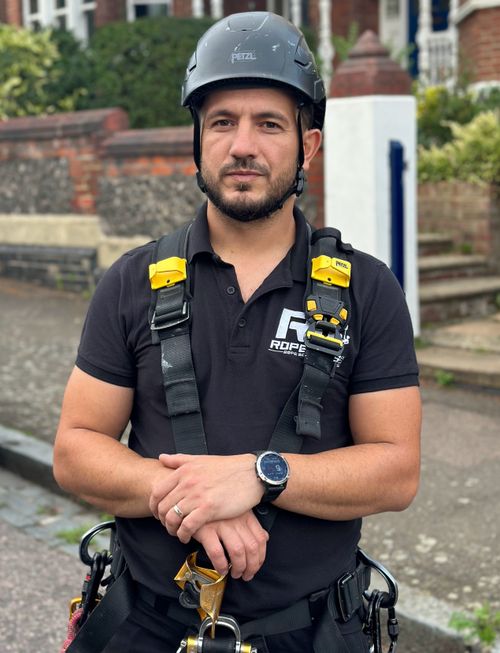
RopeGuys technician carrying out high-level brick repair on a London façade

Damaged bricks & local replacement • Greater London

Rope Access Brick Repair London

RopeGuys provides rope access brick repair in London for commercial buildings, apartment blocks and managed properties with damaged masonry at high or restricted locations. Our technicians can reach cracked, spalled, fractured or locally displaced bricks on façades, parapets, window surrounds and courtyard elevations where full scaffolding may be disproportionate to a defined repair.

This page is specifically about the brick units themselves. Failed mortar joints are covered separately by our Brick Repointing & Masonry Repair London service. Keeping those services distinct helps property managers obtain the right investigation, materials and repair method.

RopeGuys is supervised by experienced IRATA Level 3 personnel. Ionut Caimac has 18 years of published industry experience and Zoltan Abraham has 15 years. We provide close visual access, practical repair work within an agreed scope and photographic evidence from areas that cannot be reviewed safely from the ground.

Request a Free Brick Repair Quote

Call 07909 983036

WhatsApp RopeGuys

Since 2006Team experience
IRATA Level 3Published supervisors
Brick focusedRepair not repointing
London basedKingston upon Thames

RopeGuys London

What Is Rope Access Brick Repair?

Rope access brick repair combines specialist access with local masonry work. Technicians use planned rope systems to position beside damaged brickwork, inspect the immediate area and carry out a suitable agreed repair.

Depending on condition and specification, work may include removing and replacing individual damaged bricks, making good local masonry, repairing minor surface loss with a compatible system or supporting a specialist investigation. Rope access solves the access problem; it does not remove the need to understand why damage occurred.

A direct answer for property managers

Rope access brick repair is suitable for localised damaged bricks on high façades where technicians can establish safe positioning and handle the required materials. It can avoid erecting scaffold across a large elevation for a small repair, but extensive rebuilding or structural movement may require scaffolding and professional design.

Brick repair versus repointing

Repointing replaces deteriorated mortar between bricks. Brick repair addresses damage to the masonry units: cracks through the brick, spalled faces, fractures, missing sections, impact damage or units that need replacement.

The two conditions can occur together. A damaged brick may sit beside failed mortar, but each component must be assessed separately. New pointing alone does not restore a fractured brick.

Repair versus replacement

Some local surface damage may be suitable for a specified repair material. Other bricks need careful removal and replacement with a compatible unit. The decision depends on depth of damage, exposure, appearance, availability of matching bricks and whether the defect affects stability.

RopeGuys does not promise invisible colour matching. New or repaired masonry can differ from surrounding weathered brickwork.

Structural limits

Cracking patterns, bulging walls, displaced masonry, failed lintels and widespread movement can indicate a larger issue. In these cases, a chartered surveyor or structural engineer may need to determine cause and repair design.

We can provide close photographs and access support, but a visual rope access visit is not automatically a structural survey.

RopeGuys London

When Is Brick Repair Necessary?

Brick damage should be reviewed when it creates a loose-material risk, exposes the wall to additional weathering or suggests ongoing movement. Early inspection helps separate cosmetic surface change from a defect requiring prompt action.

Common warning signs include:

  • cracked bricks rather than cracks limited to mortar joints;
  • flaking or spalled brick faces;
  • loose fragments found below an elevation;
  • bricks displaced from the surrounding plane;
  • open holes or missing masonry sections;
  • impact damage around service routes or fixtures;
  • repeated cracking around window heads or parapets;
  • frost-damaged or saturated brickwork;
  • rust staining around embedded metal;
  • previous patch repairs becoming detached;
  • visible deterioration beside leaking gutters or roof details;
  • local damage following installation or removal of signs and equipment.

Spalled brick faces

Spalling occurs when the outer face breaks away. Moisture, freeze-thaw action, salt, incompatible coatings and hard mortar can contribute. The depth and cause matter: a shallow defect differs from a brick that has lost a substantial part of its section.

Cracked bricks

A single isolated crack may result from local damage, while repeated stepped or vertical patterns may reflect movement elsewhere in the wall. Filling the visible crack without understanding the pattern can conceal evidence rather than solve the cause.

Loose or displaced units

Any brick or fragment that appears unstable above an entrance, pavement or occupied area deserves prompt attention. The area below may need immediate control before a close inspection is arranged.

Damage around metalwork

Corroding embedded metal can expand and fracture surrounding masonry. Painting over rust staining or patching the face may not address the concealed source. Specialist investigation may be required.

Water-related deterioration

Overflowing gutters, open parapets, failed sealant and defective flashings can keep masonry wet. The water source should be corrected as part of a durable maintenance plan. See our Roof Inspection & Maintenance London service for high-level roof and parapet condition checks.

RopeGuys London

Rope Access Brick Repair Services

The repair method is agreed after reviewing access, brick condition, likely cause and material requirements.

RopeGuys technician working on damaged high-level brickwork
Genuine RopeGuys brick façade maintenance at height.

Individual brick replacement

Where appropriate, a damaged unit can be carefully removed without unnecessarily disturbing surrounding sound masonry. A compatible replacement is installed and the joints are made good to an agreed finish.

Matching dimensions, colour, texture, strength and water absorption may be important. Historic or unusual masonry can require specialist sourcing.

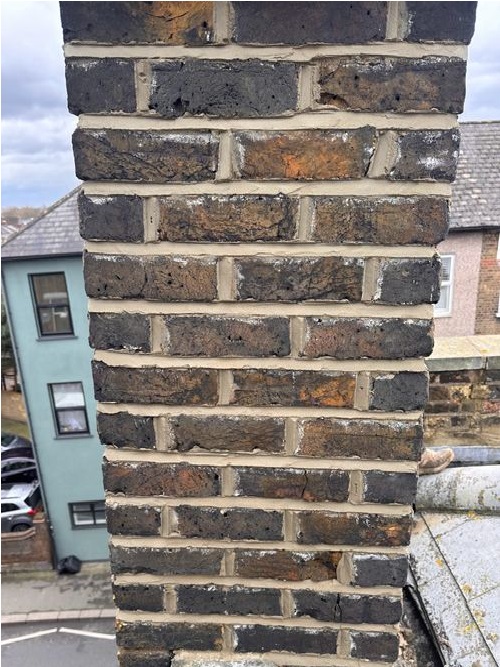
Close inspection of cracked and damaged masonry
Close access helps distinguish brick damage from failed mortar.

Localised spalled-brick repair

Some limited surface loss may be repaired using a compatible masonry repair system where replacement is not necessary or practical. Preparation must remove unstable material and create a suitable repair boundary.

The product must suit the brick, depth and exposure. A thin cosmetic covering over loose material is not a durable repair.

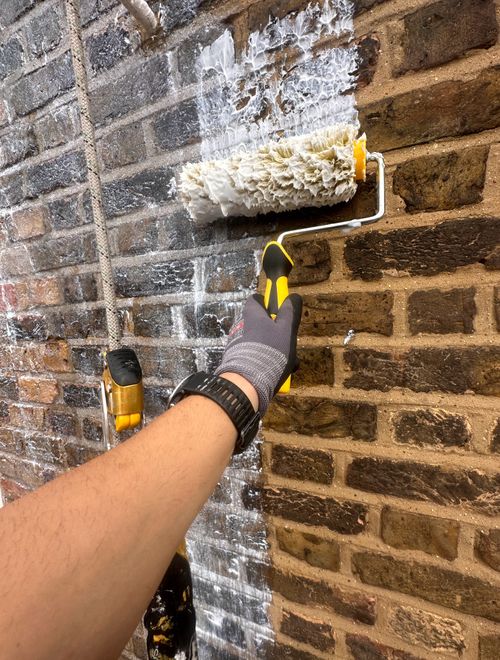
RopeGuys technician working on brick and mortar at height
Brick repair and repointing are assessed as separate components.

Crack investigation and making good

RopeGuys can provide close photographs and suitable local making good where the crack’s cause and repair method are sufficiently clear. Repeated, wide or patterned cracking may require monitoring or engineering advice before work.

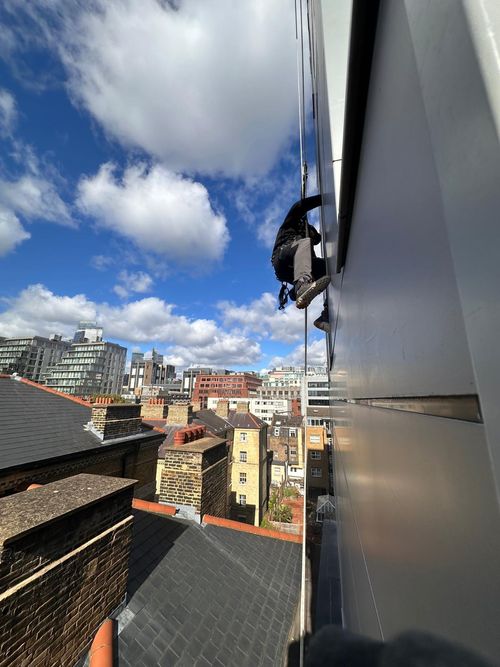
Rope access technician positioned on a difficult brick elevation
Targeted access can suit isolated high-level masonry defects.

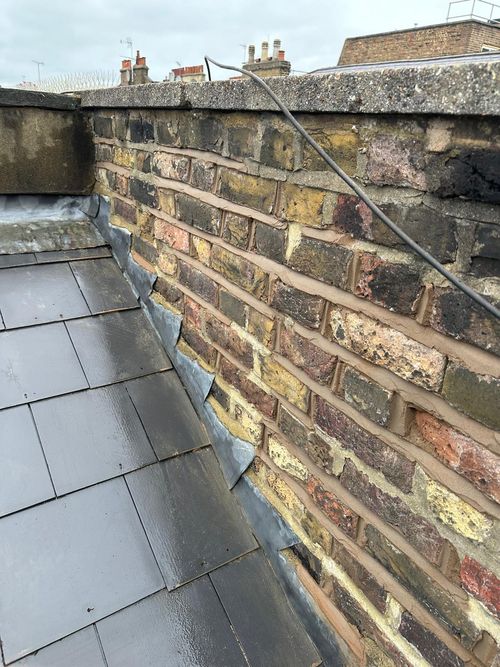
Parapet brick repairs

Parapets are highly exposed to rain, wind and temperature change. Damaged bricks can interact with coping joints, flashings and mortar deterioration.

Repairs should address the complete visible detail rather than replacing one brick while leaving an active water source untouched.

High-level façade condition inspection by RopeGuys
Photographic evidence supports the correct repair decision.

Window heads, sills and reveals

Brickwork around windows can be affected by movement, runoff, lintel problems and earlier alterations. RopeGuys can repair suitable local damage while keeping structural supports and sealant interfaces within their correct specialist scopes.

Ionut Caimac, RopeGuys IRATA Level 3 Supervisor

Making good around redundant fixings

Signs, brackets, cables and façade equipment can leave damaged units or enlarged holes after removal. Suitable local replacement or making good may be included.

Structural anchors, façade restraint systems and safety-critical fixings require competent design and testing rather than ordinary masonry patching.

RopeGuys technician working on damaged high-level brickwork
Genuine RopeGuys brick façade maintenance at height.

Emergency loose-material response

Where conditions and safe planning permit, rope access can support urgent close inspection and removal of clearly loose fragments. This may be an initial risk-reduction stage rather than the permanent repair.

Close inspection of cracked and damaged masonry
Close access helps distinguish brick damage from failed mortar.

Photographic condition records

Images can document the overall location, close damage, preparation and completed repair. They help owners and managers understand areas that remain inaccessible from ground level.

RopeGuys London

Advantages of Rope Access for Brick Repairs

Focused access

Technicians can reach selected bricks without automatically covering an entire elevation with scaffold. This is particularly useful when the defect is small but high.

Reduced ground occupation

Rope access can reduce the footprint around busy London pavements, courtyards and entrances. Controlled areas below the work are still required.

Close inspection before repair

The true depth of a crack or spall may only become clear at the work position. Close access allows the team to photograph the defect and confirm whether the planned method remains appropriate.

Suitable for occupied buildings

Work can often be coordinated around residents, offices and deliveries, subject to exclusion areas, noise, dust and building access.

Related maintenance can be identified

Technicians may observe failed pointing, sealant, drainage or roof-edge details near the damaged brick. These items are reported separately and are not added without approval.

When another access method is preferable

Extensive rebuilding, broad instability, heavy material handling or long-duration work may require scaffold. Powered access can be appropriate where a machine can reach from stable permitted ground.

RopeGuys assesses the complete task rather than assuming rope access is always the best option.

RopeGuys London

Our Brick Repair Process

01

1. Initial information

Send the postcode, wide elevation photographs and close images of the damaged masonry. Explain whether fragments have fallen, when damage was first noticed and whether a professional report exists.

02

2. Risk and access review

We consider location, height, potential instability, public areas, rope arrangements, roof access and neighbouring property. Urgent loose-material concerns are prioritised differently from routine cosmetic repairs.

03

3. Condition assessment

The team distinguishes damage to brick units from failed mortar, coatings and sealants. We also look for visible patterns that may require a surveyor or engineer.

04

4. Repair specification and materials

The quotation defines whether the scope involves replacement, local repair, making good or investigation. Brick sourcing, appearance, mortar and repair products are agreed as far as practical.

05

5. Project-specific planning

Access, controlled areas, tools, debris containment, material handling, weather and rescue arrangements are planned for the building. Client documentation requirements should be confirmed before mobilisation.

06

6. Controlled removal and preparation

Loose material is removed carefully. For brick replacement, the damaged unit is extracted while limiting disturbance to surrounding masonry. Repair areas are prepared to the specified depth and condition.

07

7. Installation or repair

The replacement unit or repair material is installed using compatible materials and the agreed finish. Application and curing requirements are followed.

08

8. Weather protection and curing

Rain, frost, heat and strong wind can affect masonry work. The programme may change where conditions would compromise safety or performance.

09

9. Completion evidence

Where agreed, photographs record the completed work and any visible concerns beyond scope. Additional repairs require separate approval.

RopeGuys London

Why Choose RopeGuys for Brick Repair?

IRATA Level 3 supervision

RopeGuys publicly identifies Ionut Caimac and Zoltan Abraham as IRATA Level 3 Supervisors with 18 and 15 years of stated industry experience.

Genuine façade project imagery

The RopeGuys Media Library contains real images of technicians working directly on London brick façades. We do not invent client names, addresses, values or repair outcomes.

Clear separation of masonry defects

We distinguish damaged bricks, failed mortar, sealant problems and structural movement. This helps avoid using the wrong repair for the visible symptom.

Photographic communication

Close photographs support clear decisions and completion records for areas clients cannot safely inspect.

Honest recommendations

We explain when the work needs an engineer, specialist brick supplier, scaffold or another contractor rather than presenting rope access as a universal answer.

RopeGuys London

Industries and Buildings We Serve

Commercial offices

Local brick damage above entrances, pavements and lower roofs can be investigated and repaired around building operations.

Residential blocks

Managed apartment buildings often have inaccessible courtyard walls, parapets, window surrounds and side elevations.

Hotels and hospitality

Work can be coordinated around guest areas, deliveries and appearance requirements.

Retail and mixed-use properties

Busy public frontages require careful exclusion areas and communication between commercial and residential users.

Schools and public buildings

Projects may require restricted working periods and site-specific controls.

Traditional and heritage masonry

Older or unusual bricks may require specialist sourcing, conservation input and compatible mortar. Rope access solves access but does not replace conservation expertise.

RopeGuys London

Genuine RopeGuys Brickwork Examples

The following examples are based on genuine RopeGuys project imagery. Exact locations and client identities are not published because permission has not been established.

RopeGuys technician working on brick and mortar at height
Brick repair and repointing are assessed as separate components.

High-level brick façade maintenance

Images show technicians positioned beside external brickwork, demonstrating close access to isolated defects and surrounding joints.

Rope access technician positioned on a difficult brick elevation
Targeted access can suit isolated high-level masonry defects.

Close masonry inspection

Project photography records cracks and façade details that cannot be assessed accurately from the pavement. This evidence helps distinguish repointing from brick-unit repair.

High-level façade condition inspection by RopeGuys
Photographic evidence supports the correct repair decision.

Related parapet and elevation work

Genuine high-level maintenance images show exposed masonry interfaces where water, mortar and brick condition must be considered together.

RopeGuys London

Rope Access Brick Repair Areas in London

RopeGuys is based at 10 Florence Road, Kingston upon Thames, KT2 6JW, and works throughout Greater London.

Areas include Kingston upon Thames, Richmond, Twickenham, Wimbledon, Putney, Wandsworth, Chelsea, Kensington, Hammersmith, Fulham, Westminster, Lambeth, Southwark, Croydon, Ealing, Brent, Camden, Islington, Hackney, Tower Hamlets and Greenwich.

Send the postcode, building photographs and approximate height even if the location is outside this list.

Learn more about RopeGuys, explore Rope Access London or use the homepage quotation form.

Kingston upon ThamesRichmondTwickenhamWimbledonPutneyWandsworthChelseaKensingtonHammersmithFulhamWestminsterLambethSouthwarkCroydonEalingBrentCamdenIslingtonHackneyTower HamletsGreenwich

Clear answers

Rope Access Brick Repair Frequently Asked Questions

What is the difference between brick repair and repointing?

Brick repair addresses damaged masonry units. Repointing replaces defective mortar between otherwise suitable bricks.

Can damaged bricks be replaced using rope access?

Yes, where the location, wall condition, materials and safe positioning make local replacement practical.

Can you repair spalled bricks?

Some limited surface loss may suit a compatible repair system; deeper damage may require brick replacement.

Can you repair structural cracks?

Structural diagnosis and design require an appropriately qualified professional. RopeGuys can provide close access, photographs and repairs to an agreed specification.

What causes brick faces to break away?

Possible factors include moisture, freeze-thaw action, salts, incompatible hard mortar, coatings, corrosion and impact. The likely cause should inform the repair.

Can you match replacement bricks?

We can seek compatible bricks, but exact colour and texture matching may be difficult on weathered or historic façades.

Is rope access suitable for an entire wall rebuild?

Usually not. Extensive rebuilding and heavy material handling are more likely to require scaffold or another engineered access system.

Can you remove loose bricks urgently?

Urgent inspection and risk reduction may be possible subject to access, weather and safe planning. A permanent repair may follow separately.

Do you repair mortar around replacement bricks?

Yes, joints around an agreed replacement are made good using a suitable mortar. Wider repointing is scoped separately.

Can brick repair stop water ingress?

It may address an identified entry point, but water can also come from roofs, gutters, sealants and concealed construction.

Does weather affect masonry repairs?

Yes. Rain, frost, heat and wind can affect access, application and curing.

Can you work on occupied buildings?

Yes, subject to controlled areas, access arrangements and communication with the building contact.

Do you provide photographs?

Photographic records can be included where practical and agreed.

Are projects supervised by IRATA Level 3 personnel?

RopeGuys publicly identifies two IRATA Level 3 Supervisors, Ionut Caimac and Zoltan Abraham.

How do I request a brick repair quote?

Call 07909 983036, email info@ropeguys.co.uk, send a WhatsApp message or complete the form below.

Free initial quotation

Request a Rope Access Brick Repair Quote

Send the postcode, approximate height, wide and close photographs and details of any fallen material or previous reports.

We will assess whether rope access is appropriate, distinguish brick repair from repointing and provide a written quotation for the agreed scope.

Request a Free Quote

Call 07909 983036

WhatsApp RopeGuys

Tell us about the building

Include the postcode, approximate height and photographs where possible.