
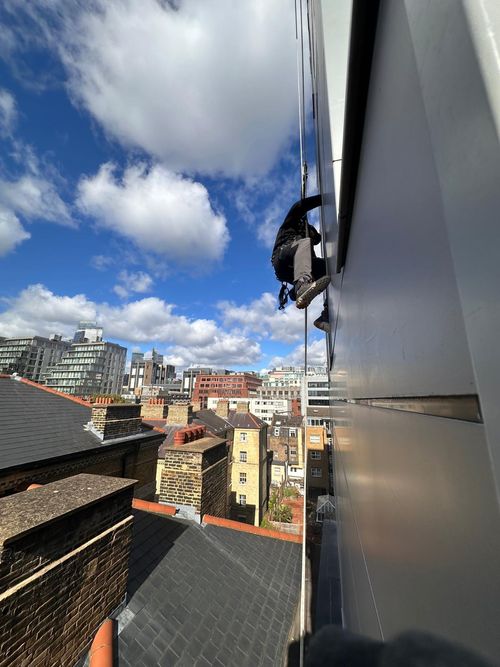
Bird Proofing London
Ropeguys provides bird proofing in London for commercial buildings, residential blocks, apartment buildings and difficult-access façades where birds are causing fouling, staining, blocked drainage or repeat maintenance problems.
Our work is strongest where bird deterrent installation needs rope access, careful planning and close high-level building knowledge. We can inspect roof edges, parapets, signage, plant areas, ledges and courtyards, then advise on practical deterrent options where the work is safe, lawful and appropriate.
Ropeguys links bird proofing with rope access services, commercial window cleaning, gutter cleaning, roof inspection and wider building maintenance.
What Is Bird Proofing?
Bird proofing is the use of physical deterrents and exclusion measures to discourage birds from landing, roosting, nesting or fouling specific parts of a building. On London properties, it often focuses on ledges, beams, parapets, window heads, signage, roof edges, gutters, balconies, plant areas and recessed façade details.
The aim is not to harm birds. The aim is to prevent repeat use of problem areas using suitable deterrents, installed correctly, with access planned around the building. On high or awkward buildings, rope access can allow the installer to reach ledges and roof edges without a full scaffold, subject to anchor points, exclusion zones, weather and site controls.
A direct answer for property managers
Bird proofing London is usually needed when the same parts of a building are repeatedly affected by droppings, nesting material, blocked gutters, staining, odour, resident complaints or difficult cleaning access. A useful quotation should identify the affected areas, the access method, the likely deterrent type, any cleaning needed first and any legal or seasonal restrictions.
Bird proofing versus bird control
Bird proofing is normally about prevention and exclusion: spikes, post-and-wire, netting, mesh, gels, ledge modification or other deterrent systems. Bird control can be a broader pest-management term and may involve specialist licensing, trapping or species management. Ropeguys focuses on building access, inspection, cleaning coordination and installation of appropriate high-level deterrents.
Why access matters
Bird deterrents only work when they are installed where birds actually land or enter. A strip placed too far back, a net with gaps, poor fixing into weak substrate or missing returns around corners can leave the problem in place. Rope access can help because technicians can work close to the detail, record what they see and install to the agreed line rather than guessing from the ground.
Legal and seasonal care
All wild birds, their eggs and nests are protected by law in England. GOV.UK guidance explains that work should avoid harming birds, especially during breeding season, and that active nests must not be damaged or destroyed. Ropeguys does not present bird proofing as a way to bypass wildlife law. If active nesting is present or suspected, timing, method and responsibility must be reviewed before work proceeds.
When bird proofing is not the first step
If a ledge is heavily fouled, a gutter is blocked or a roof outlet is full of nesting material, cleaning and inspection may be needed before deterrents are installed. If the structure is loose, cracked or heavily corroded, the fixing may not be suitable without repair. If the issue involves protected species or active nests, a specialist ecological or pest-control assessment may be needed.
Bird Proofing Services in London
Ropeguys provides bird proofing services in London for difficult-access and high-level building areas. The final method depends on the building detail, bird pressure, visibility, substrate, public access below and maintenance requirements.
Bird spike installation London
Bird spikes can discourage pigeons and larger birds from landing on suitable ledges, parapets, beams, signs and window heads. They must be selected and fixed correctly for the ledge depth and bird pressure. Poorly positioned spikes can leave landing space behind or beside the strip.
Bird netting London
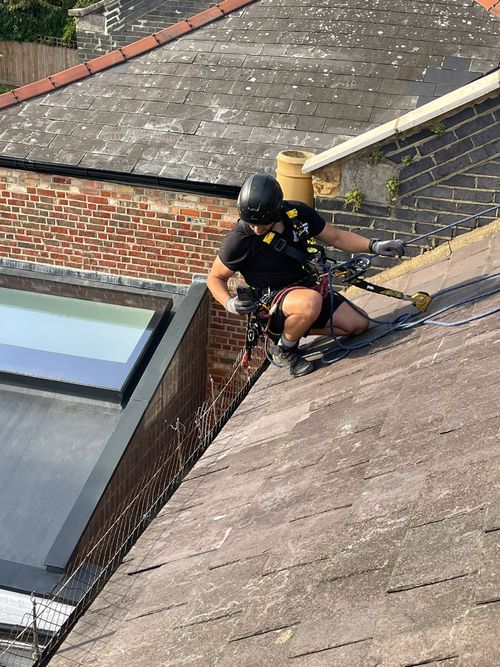
Bird netting can exclude birds from recessed areas, plant zones, undercroft spaces, lightwells and other voids where a barrier is more appropriate than a landing deterrent. Netting needs correct fixings, tensioning, perimeter closure and future inspection because gaps can make the system ineffective.
Post and wire systems
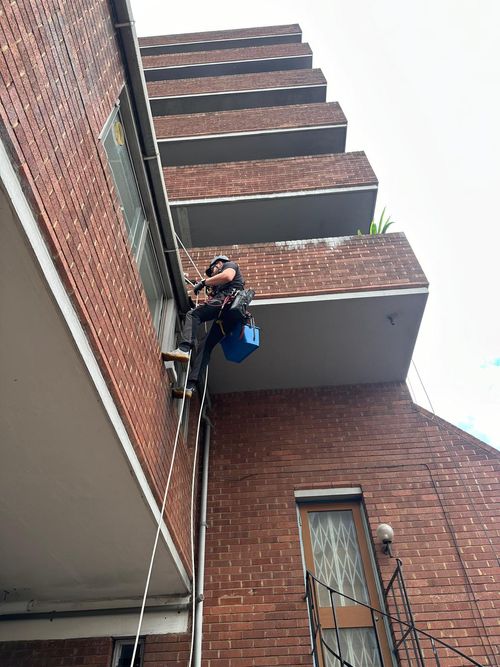
Post and wire systems are sometimes used where a lower-profile deterrent is preferred on ledges, cornices or architectural details. Suitability depends on ledge width, bird pressure and the visual standard expected by the client.
Mesh and access-point closure
Mesh can be useful for vents, openings, voids and other access points where birds are entering rather than simply landing. The detail must not block ventilation or drainage unless that has been reviewed and agreed.
Bird fouling clean-up before proofing
Deterrents should usually be installed onto a suitable surface. Where droppings, nesting material, moss or debris are present, the affected area may need cleaning first. Ropeguys can coordinate bird fouling clean-up with commercial window cleaning, gutter cleaning or roof-edge maintenance where appropriate.
Roof and gutter bird proofing
Bird activity around roof edges can contribute to blocked gutters, stained façades and recurring overflow. Ropeguys can inspect accessible roof drainage routes and advise whether cleaning, proofing, gutter repair or roof inspection is the right next step.
Signage and high-level façade deterrents
Commercial signs, shopfront details, projecting ledges and façade bands can become regular roosting points. Rope access may allow deterrent installation without a full scaffold, reducing disruption where the scope is local and access can be planned safely.
Balcony, lightwell and courtyard bird proofing
Residential blocks and managed properties often have courtyards, lightwells, balconies and recessed ledges that are difficult to reach from below. Ropeguys can assess whether rope access, roof access, internal access or another method is more suitable.
Bird Proofing for Commercial Buildings
Commercial bird proofing London often involves visible, operational buildings where disruption, safety and presentation matter. Offices, hotels, shops, schools, healthcare premises, mixed-use blocks and hospitality sites may all need different controls.
Offices and managed commercial premises
Office buildings can suffer from bird fouling around roof edges, plant areas, window ledges, entrance canopies and signage. Proofing may need to be coordinated with tenants, security, reception teams and cleaning schedules.
Retail and hospitality buildings
Bird fouling near entrances, terraces, signage or guest routes can affect the way a building feels before anyone reaches reception. Work may need to happen outside peak trading hours or with clear pedestrian management below.
Schools and healthcare premises
These sites need careful planning, clear exclusion zones and tidy documentation. Bird proofing may be part of wider planned maintenance rather than a one-off reactive job.
Industrial and logistics buildings
Birds can affect loading bays, gutters, roof drainage, signage, rooflights and service yards. Proofing work may need to consider vehicle movement, delivery windows and access restrictions.
Bird Proofing for Blocks, Apartments and Property Managers
Managed residential buildings need bird proofing that is practical, documented and easy to explain to residents. Ropeguys understands that managing agents often need a clear scope, photographs and evidence that the correct areas have been addressed.
Blocks of flats
Apartment blocks often have repeated bird activity around roof edges, balconies, window heads, parapets, courtyards and service areas. A small untreated gap can leave residents with the same problem after the first rain or nesting cycle.
Mansion blocks and converted buildings
Older London buildings may have architectural details, cornices, decorative ledges and delicate surfaces. Bird proofing must balance deterrent performance with appearance, substrate condition and the risk of damaging existing finishes.
Resident communication
Residents may need to know when rope access technicians will be working near windows or balconies. Ropeguys can coordinate with the responsible building contact so notices, access restrictions and timings are clear.
Evidence for leaseholders and freeholders
Photographs can help explain what was installed, where bird pressure was observed and which areas remain outside the agreed scope. This is useful for service-charge communication and future maintenance planning.
Bird Proofing for Houses and Residential Properties
Residential bird proofing London can involve tall townhouses, converted properties, extensions, rear elevations, lightwells and roof-edge details where access is awkward. Ropeguys is not trying to replace every domestic pest-control contractor. The best fit is where the problem is high, external, difficult to reach or connected to wider roof and façade maintenance.
Tall townhouses
Townhouses can have high front ledges, rear roof edges, parapets and dormer details that are difficult to access safely from ladders. Rope access may be appropriate where anchor points and site conditions allow.
Converted properties
Converted houses often have shared responsibility, multiple residents and old roof details. Bird proofing may need to be planned with the freeholder or managing agent rather than a single occupier.
Balconies and recessed ledges
Bird activity on balconies and ledges may need a combination of cleaning, deterrent installation and resident behaviour changes, especially if food waste or open sheltered areas are encouraging repeat visits.
When to use a pest-control specialist
If the issue involves active nests, trapping, species control, licensing or complex ecological risk, a specialist pest-control or ecological consultant may be required. Ropeguys can still support difficult access and installation where the scope is suitable and lawful.
Why Choose Ropeguys for Bird Proofing London?
Bird proofing is only as good as the access, preparation, fixing and understanding of the building. Ropeguys brings rope access and external building-maintenance experience to high-level deterrent work.
Rope access for difficult areas
Many bird proofing problems sit exactly where access is hardest: roof edges, parapets, signs, cornices, lightwells, internal courtyards and upper-storey ledges. Rope access can help reach these areas without assuming scaffold is the only answer.
Building-maintenance context
Bird fouling often overlaps with blocked gutters, stained façades, leaking roof edges, dirty glazing or damaged sealant. Ropeguys can connect bird proofing with building maintenance, roof inspection, gutter cleaning and sealant replacement.
Photographic evidence
Property managers need evidence, not vague reassurance. Ropeguys can provide photographs where practical so the client can see affected areas, installed deterrents and obvious surrounding issues.
Practical access advice
Rope access is not always the right method. Scaffold, MEWP, roof access, internal access or specialist pest-control work may be better in some cases. Ropeguys will say so when the access method or scope needs a different approach.
Commercial and residential experience
Ropeguys works across commercial buildings, managed residential blocks, private properties and difficult-access external areas. That helps when bird proofing needs to be coordinated around residents, tenants, entrances or public routes.
Brand-safe and appearance-aware
On commercial façades and residential blocks, the finished installation should be functional but not careless. The choice of deterrent, fixings and visible lines should reflect the building, not just the product catalogue.
Indicative Bird Proofing Prices in London
Bird proofing pricing depends on access, height, deterrent type, bird pressure, cleaning requirement, material, fixing method, length of ledge, number of locations and whether surveys or legal constraints affect timing.
| Bird proofing scope | Indicative range | Typical access | Notes |
|---|---|---|---|
| Small ledge spike installation | From £250-£650 | Ladder, roof access or rope access | Depends on height, ledge length and preparation. |
| Local rope access bird proofing | From £650-£1,800 | Rope access | Useful for high ledges, signage, parapets or difficult elevations. |
| Bird netting to recessed area | From £950-£3,500+ | Rope access, roof access or combined method | Price depends on fixings, perimeter complexity and net size. |
| Bird fouling clean-up before proofing | From £350-£1,500+ | Method varies | May need PPE, waste handling and surface washing. |
| Apartment block bird proofing | From £1,200-£5,000+ | Rope access or mixed access | Multiple elevations and resident coordination increase scope. |
| Commercial bird proofing programme | From £1,500-£7,500+ | Planned access mix | Suitable for recurring issues across several elevations or roof areas. |
What affects the price?
The biggest factors are access, amount of material, ledge length, fixing complexity, cleaning required first, public protection below, working hours and whether active nesting creates a timing issue.
Why cheap bird proofing can fail
Low-cost installations often fail because the wrong deterrent is used, the ledge is not cleaned, the fixing is poor, the line is incomplete or adjacent landing points are ignored. A bird proofing system must be designed around bird behaviour and the building detail.
How to get an accurate quote
Send photographs, the postcode, the affected elevations, approximate height, any access information and a description of the recurring problem. If residents or tenants are affected, include timing restrictions and the areas they report.
Our Bird Proofing Process
1. Initial information
We review the address, photographs, affected areas, building type, access notes and whether the issue is droppings, nesting material, blocked drainage or repeated roosting.
2. Access review
Ropeguys considers whether rope access, roof access, MEWP, scaffold, internal access or a combination is the safest and most practical method.
3. Bird activity and legal check
We look for signs that active nesting may affect timing or method. If active nests are present or suspected, the next step must be handled lawfully and may need specialist advice.
4. Cleaning and preparation scope
If droppings, nesting material or debris are present, cleaning may be needed before deterrents can be installed correctly.
5. Deterrent selection
The proposed method may include spikes, netting, mesh, post-and-wire, ledge modification or another suitable deterrent. The choice depends on the surface, species pressure, appearance and maintenance needs.
6. Quotation and method
The quote should define the areas to be proofed, access method, assumptions, exclusions, working hours and any conditions that may change the scope.
7. Installation
Technicians install the agreed deterrents using suitable access and site controls. Work is coordinated around residents, tenants, pedestrians or operational areas where required.
8. Photographs and recommendations
Where practical, Ropeguys records the completed work and notes any surrounding maintenance issues such as blocked gutters, damaged sealant, loose masonry or roof-edge defects.
Genuine Ropeguys Bird Proofing Access Examples
These examples use genuine Ropeguys project imagery for high-level access and building maintenance. Exact addresses and client identities are not published.
Roof-edge and parapet access
Bird proofing often starts at roof edges, parapets and high-level ledges. Ropeguys access experience helps technicians work close to these details and record surrounding condition.
Gutter and drainage interfaces
Bird activity can add nesting material and debris to gutters, hoppers and roof outlets. Proofing may need to be coordinated with gutter cleaning or roof drainage inspection.
Signage and façade ledges
Signs, decorative ledges and projecting façade bands can become regular roosting points. Local deterrent installation may reduce repeated fouling when the correct landing points are addressed.
Courtyards and lightwells
Internal courtyards and lightwells can be awkward, restricted and difficult to scaffold. Rope access may provide a practical way to inspect and install deterrents where safe.
Bird Proofing Areas We Cover in Greater London
Ropeguys is based at 10 Florence Road, Kingston upon Thames, KT2 6JW, and provides bird proofing services across Greater London, subject to access, scheduling and project scope.
We regularly work across South West London, West London, Central London, South London, North London and East London. Coverage includes Kingston upon Thames, Richmond, Twickenham, Wimbledon, Putney, Wandsworth, Chelsea, Kensington, Hammersmith, Fulham, Westminster, Lambeth, Southwark, Croydon, Ealing, Brent, Camden, Islington, Hackney, Tower Hamlets and Greenwich.
Learn more about Ropeguys, visit Rope Access London, review Commercial Window Cleaning London or explore the wider services hub.
Check Bird Proofing Availability
Bird Proofing London Frequently Asked Questions
Do you provide bird proofing in London?
Yes. Ropeguys provides bird proofing in London for commercial buildings, residential blocks, apartment buildings and difficult-access external areas where rope access is suitable.
What types of bird proofing do you install?
Depending on the building, we can install suitable deterrents such as spikes, netting, mesh, post-and-wire or access-point closure. The best method depends on the affected detail and bird pressure.
Is bird proofing legal in the UK?
Bird proofing can be legal when planned correctly and installed without harming birds or interfering with active nests. GOV.UK guidance explains that wild birds, their eggs and nests are protected by law, so timing and method matter.
Can you remove active bird nests?
Ropeguys does not treat active nest removal as a routine building-maintenance task. If active nesting is present or suspected, the legal position and any need for specialist advice must be reviewed before work proceeds.
Do you install pigeon spikes?
Yes, where spikes are suitable for the surface, ledge width and bird pressure. Spikes must be installed correctly and may not be the best option for every location.
Do you install bird netting?
Yes, where netting is suitable and can be fixed correctly. Netting is often useful for recessed areas, plant spaces, voids and protected zones, but it must be tensioned and closed properly.
Can bird proofing help with blocked gutters?
It can help reduce future debris and nesting material in some areas, but blocked gutters may need cleaning first. See Gutter Cleaning London for gutter clearance.
Can bird proofing be done by rope access?
Yes, rope access can be suitable for high ledges, roof edges, façades, signs, lightwells and courtyards where other access methods are disproportionate or difficult.
Do you clean bird droppings before proofing?
Where required and agreed, cleaning can be included before deterrents are installed. The cleaning method depends on the surface, contamination level and access.
Do you work on commercial buildings?
Yes. Ropeguys can support offices, hotels, retail buildings, schools, healthcare premises, mixed-use developments and managed commercial sites.
Do you work on residential blocks?
Yes. Ropeguys can support apartment blocks, mansion blocks, converted properties and managed residential buildings where access and site coordination are suitable.
How long does bird proofing last?
Service life depends on material, fixing quality, exposure, bird pressure, maintenance and whether the correct deterrent was selected for the location.
Will bird proofing damage the building?
The fixing method should be selected carefully for the substrate. Fragile, listed, decorative or weather-sensitive areas may need a more cautious approach.
Can you provide photographs?
Yes, photographic records can be included where practical and agreed. This is useful for property managers, freeholders and facilities teams.
Which areas of London do you cover?
Ropeguys works across Greater London from Kingston upon Thames, subject to access, scheduling and project scope.
How do I request a bird proofing quote?
Send the postcode, photographs, approximate height, affected areas and a description of the bird activity. You can call, email, WhatsApp or use the form below.
Request a Bird Proofing Quote in London
If you need bird proofing London for a commercial building, apartment block, managed property, roof edge, ledge, sign, balcony, courtyard or difficult-access façade, send the details to Ropeguys.
Useful information includes:
- building postcode;
- photographs of the affected area;
- approximate height and access notes;
- whether birds are landing, nesting or fouling;
- whether any active nests are visible;
- whether cleaning is needed before deterrents;
- preferred working times;
- site contact details.
Ropeguys will assess the access, likely deterrent options and whether rope access, cleaning, specialist pest-control input or a wider building-maintenance scope is the right next step.
Tell us about the building
Include the postcode, approximate height and photographs where possible.