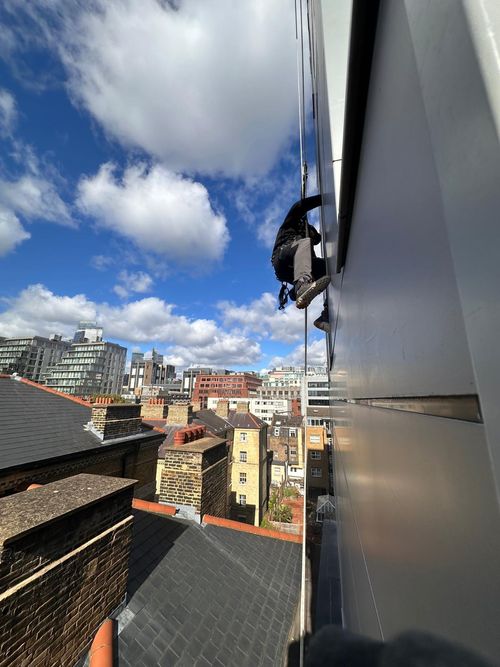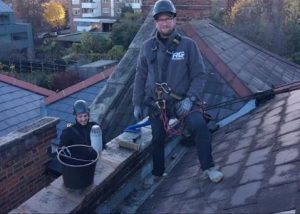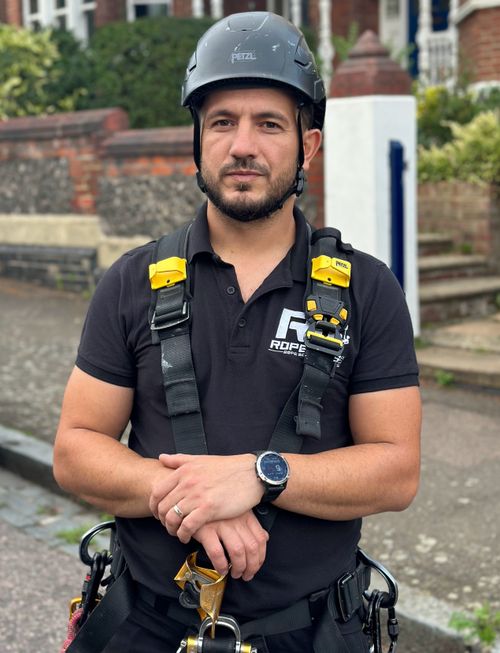
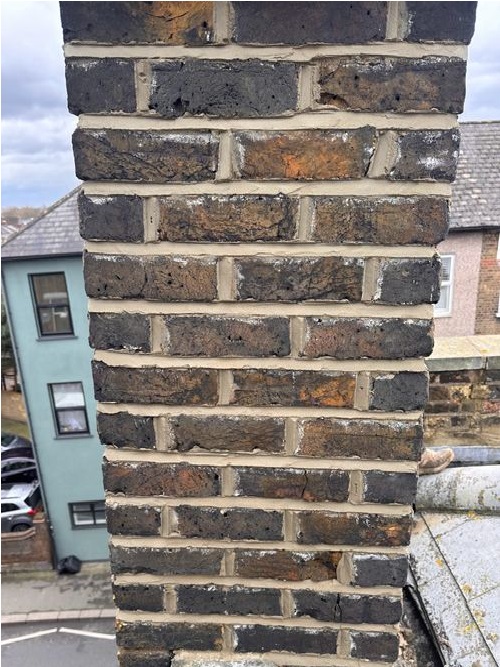
RopeGuys technician completing high-level brick repointing in London

Mortar repair & façade care • Greater London

Brick Repointing & Masonry Repair London

RopeGuys provides brick repointing and local masonry repair in London for commercial buildings, apartment blocks and managed properties with high or difficult-access façades. Our rope access technicians can work close to parapets, window surrounds, lightwells and selected elevations where full scaffolding may be disproportionate to a focused repair.

The service centres on deteriorated mortar joints and associated local masonry maintenance. We remove unsuitable loose mortar, prepare the joint and install a compatible replacement using a finish appropriate to the existing wall. Where close access reveals cracked, spalled or displaced bricks, we record the condition and explain whether a separate brick-repair scope or specialist assessment is required.

RopeGuys is supervised by experienced IRATA Level 3 personnel. Ionut Caimac has 18 years of published industry experience and Zoltan Abraham has 15 years. We combine difficult access with practical façade maintenance, photographic evidence and honest limits about what can be established visually.

Request a Free Repointing Quote

Call 07909 983036

WhatsApp RopeGuys

Since 2006Team experience
IRATA Level 3Published supervisors
Mortar focusedCompatible local repairs
London basedKingston upon Thames

RopeGuys London

What Is Brick Repointing?

Brick repointing is the removal and replacement of weathered, cracked, loose or defective mortar from the joints between masonry units. Mortar is not simply a decorative line around each brick. It helps distribute loads, accommodates limited movement and forms part of the wall’s resistance to weather.

Rain, wind, temperature change, pollution and unsuitable previous repairs can cause joints to erode or separate from brick edges. Repointing restores the joint with a mortar selected for the masonry and exposure.

A direct answer for London property managers

High-level brick repointing by rope access allows trained technicians to repair selected mortar joints on difficult-to-reach façades without automatically erecting scaffold across the whole elevation. It is most suitable for defined areas of failed pointing where safe rope arrangements can be established and the masonry is stable enough for local work.

Repointing is not surface covering

A durable repair normally requires defective material to be removed before new mortar is installed. Smearing a thin layer over loose, shallow or contaminated joints may hide the defect without creating adequate depth or bond.

Preparation depth, joint cleanliness, moisture condition, mortar consistency and finishing method all affect performance. RopeGuys agrees the practical method for the particular wall rather than treating every façade as identical.

Repointing versus brick repair

This page targets failed mortar joints and local maintenance directly associated with those joints. Brick repair is a separate intent concerning cracked, fractured, spalled, displaced or damaged bricks. It can involve removal, replacement, specialist repair or structural advice.

The planned Rope Access Brick Repair London page will remain separate. That distinction helps clients choose the right service and prevents two RopeGuys pages from competing for the same Google query.

Visual repair versus structural assessment

Local repointing can address weathered joints, but it does not correct significant movement. Stepped cracking, bulging, widespread displacement, failed support or recurring cracks may require a chartered surveyor or structural engineer.

RopeGuys can provide close photographs and practical observations. We do not describe a visual rope access inspection as a structural survey or guarantee that concealed defects do not exist.

RopeGuys London

When Is Brick Repointing Necessary?

Mortar often deteriorates gradually. From the pavement, a high elevation may appear sound even though close joints are open, powdery or deeply recessed. Planned inspection is particularly valuable on weather-facing walls and areas where previous repairs have failed.

Common signs include:

  • mortar that crumbles or powders when disturbed;
  • joints recessed significantly behind the brick face;
  • cracks running through mortar beds or vertical joints;
  • visible gaps between mortar and brick edges;
  • missing sections of pointing;
  • vegetation growing from masonry joints;
  • loose fragments found below the elevation;
  • hard patches beside softer traditional masonry;
  • repeated deterioration around parapets and window heads;
  • poorly applied shallow surface pointing;
  • erosion below gutters, outlets or leaking details.

Weathered and recessed joints

As mortar erodes, joint faces move behind the brick surface. Deep recesses can hold moisture and expose brick edges. The rate of deterioration depends on orientation, exposure, material compatibility and building details.

Not every recessed joint needs immediate replacement. Close inspection helps distinguish stable historic finishing from active loss and loose material.

Cracked or separated mortar

Fine shrinkage cracks, open joints and separation from brick edges can admit more water. The pattern matters. Local mortar failure may be suitable for repointing, while stepped or recurring cracks can indicate movement that should be understood before cosmetic repair.

Loose material above public areas

Falling mortar fragments can create a risk below entrances, pavements and courtyards. If loose material is suspected, the immediate priority may be controlling the area and arranging inspection rather than waiting for routine maintenance.

Damp can have several causes

Defective pointing can contribute to rain penetration, but water can also enter through roofs, parapets, sealants, flashings, windows and drainage. Repointing should not be sold as a universal damp cure.

Where ingress is the main concern, RopeGuys may recommend roof inspection and maintenance or a dedicated leak investigation.

Incompatible earlier repairs

Very hard or dense mortar can concentrate stress at brick edges and restrict moisture movement in some traditional walls. Soft, porous or historic brickwork may require a different approach from modern engineering brick.

Mortar selection should respond to the existing masonry, exposure and any professional specification. Colour alone is not enough.

RopeGuys London

Brick Repointing and Local Masonry Services

The final scope depends on close condition, access and material compatibility. Our quotation identifies what is included and separates confirmed work from provisional findings.

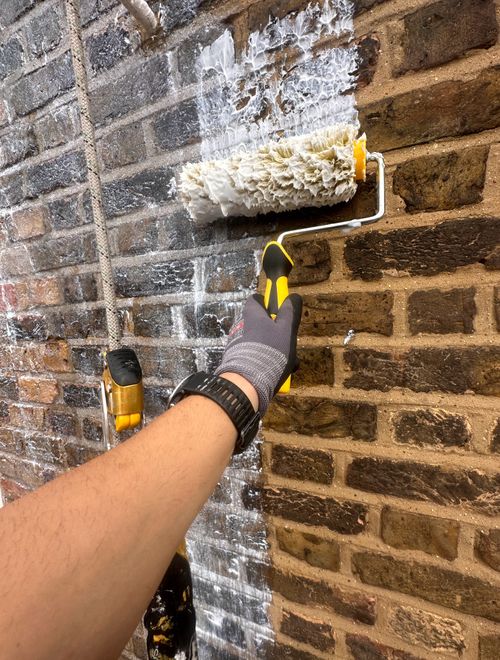
RopeGuys technician repointing high-level brickwork in London
Genuine RopeGuys brick repointing work completed using rope access.

High-level mortar joint repointing

RopeGuys can repoint defined façade areas, isolated elevations and difficult-access details. Work normally includes removing defective mortar, cleaning the joint, controlling moisture where appropriate, installing replacement mortar and finishing the profile.

The repair boundary should be logical. Repointing only the most visibly empty joint may leave adjacent loose material untouched, while unnecessarily replacing sound mortar can damage brick edges.
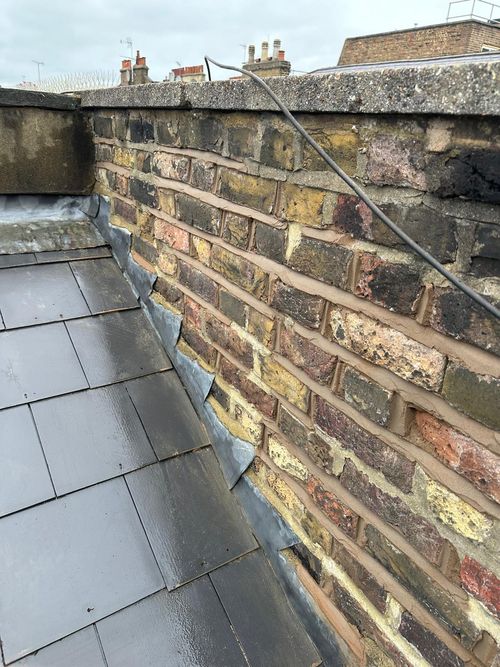
Close rope access inspection of mortar and masonry defects
Close inspection helps distinguish failed mortar from damaged brickwork.

Parapet and coping-level masonry maintenance

Parapets are exposed from several directions. Mortar around parapet brickwork and coping interfaces can deteriorate faster than sheltered wall areas.

Rope access can provide close inspection and local maintenance. Open coping joints, failed flashings or movement may require related work beyond ordinary repointing.

RopeGuys technician carrying out local masonry maintenance
Targeted high-level façade maintenance by RopeGuys.

Window heads, sills and reveals

Mortar around windows can be affected by runoff, movement and previous frame replacement. RopeGuys can inspect and repair suitable joints around heads, sills and reveals while keeping sealant and structural lintel concerns separate.

Failed perimeter sealant is not repaired with mortar. The planned Sealant Replacement London page will cover movement joints and weather seals.

Rope access technician working on a difficult London brick façade
Rope access can focus work on selected high-level masonry areas.

Local crack preparation and mortar repairs

Some cracks within mortar joints can be opened, cleaned and repaired where the cause and method are sufficiently clear. Repeated, wide or patterned cracking should be assessed before repair because new mortar can conceal useful evidence.

We photograph unexpected conditions and do not expand the scope without agreement.

High-level façade and masonry condition inspection
Photographic inspection supports clear repair decisions.

Making good around removed fixtures

Old signs, cables, brackets and redundant fixings can leave holes or local mortar damage. Suitable making-good may be included when the substrate and repair material are understood.

Fixings connected with structural support, façade retention or safety systems require competent design and should not be treated as cosmetic holes.

Ionut Caimac, RopeGuys IRATA Level 3 Supervisor

Small associated masonry repairs

The team can consider limited making good and minor defects beside the pointing area. Replacement of damaged bricks, extensive rebuilding and structural masonry work remain separate services.

RopeGuys technician repointing high-level brickwork in London
Genuine RopeGuys brick repointing work completed using rope access.

Inspection and photographic records

Where agreed, photographs can record elevation context, close defects, preparation and completed work. They are useful for managing agents and owners who cannot safely view the area.

RopeGuys London

Advantages of Rope Access for Brickwork Repairs

Rope access can reduce the temporary infrastructure required for focused high-level work. It is one access method among several and must be selected for the complete task.

Direct access to selected joints

Technicians can position close to individual mortar beds, window details, parapets and narrow elevation sections. This makes preparation and finishing more controlled than attempting to assess the wall from ground level.

Reduced occupation of ground space

London properties often have narrow pavements, courtyards, basement structures, landscaping and busy entrances. Rope access still requires controlled areas below, but it may leave more of the frontage available.

Suitable for occupied buildings

Focused work can often be coordinated around residents, office users, visitors and deliveries. Noise, dust, exclusion areas and access times still need management.

Practical for localised deterioration

If only a small high-level area has failed, installing scaffold over a broad elevation may be disproportionate. Rope access can focus the visit on the defined repair zone.

Inspection and repair can be coordinated

Where the likely defect and material are understood, close inspection and agreed repointing may form one project. If a different condition is revealed, the team records it and explains the next step.

When another access system is better

Scaffold may be preferable for extensive repointing, heavy rebuilding, large material quantities or long-duration work. Powered access can be efficient where a suitable machine can reach from stable ground.

RopeGuys does not claim rope access is always cheaper or more appropriate. The building, repair area, duration and public interface determine the strategy.

RopeGuys London

Our Brick Repointing Process

01

1. Initial information

Send the postcode, photographs and a description. Wide images show location and access, while close images show mortar texture, profile and brick condition. Tell us whether fragments have fallen, damp is present or a professional has supplied a specification.

02

2. Scope and access review

We assess height, elevation, potential rope arrangements, roof access, public areas and likely repair quantity. Complex buildings may require a site survey. The quotation defines repair areas, assumptions and exclusions.

03

3. Mortar and joint assessment

Existing brick and mortar condition influence the replacement. The objective is compatibility rather than simply finding the closest colour. Historic or unusual masonry may require analysis or a specified mix.

04

4. Project-specific planning

The team coordinates access, keys, working hours, protection and controlled areas. Planning considers tools, dust, debris containment, materials, weather and rescue arrangements.

Any documentation required by the client should be confirmed before mobilisation so it reflects the actual task.

05

5. Removal of defective mortar

Loose or unsuitable mortar is removed carefully to the agreed depth. The method should limit unnecessary damage to brick arrises and adjacent sound material. Joints are cleaned so dust and fragments do not prevent bonding.

06

6. Joint preparation and repointing

Moisture may need to be controlled so dry masonry does not pull water too quickly from fresh mortar. Replacement material is installed and compacted into the prepared joint. The finish is agreed with reference to the wall and specification.

07

7. Curing and weather protection

Strong sun, wind, frost and heavy rain can harm fresh work. The programme may change when conditions are unsuitable. Rope access does not remove normal material and curing requirements.

08

8. Completion evidence

Where agreed, RopeGuys supplies photographs and notes visible concerns outside the scope. Additional defects do not become unauthorised work.

RopeGuys London

Why Choose RopeGuys for Brick Repointing?

Experienced IRATA Level 3 supervision

RopeGuys publicly identifies Ionut Caimac as an IRATA Level 3 Supervisor with 18 years of stated experience and Zoltan Abraham as an IRATA Level 3 Supervisor with 15 years.

Genuine masonry project photography

Our Media Library contains real photographs of RopeGuys technicians completing brick repointing and high-level façade work. We use those images without inventing clients, addresses, values or outcomes.

Honest distinction between repair types

We separate failed mortar, damaged bricks, structural movement and water-ingress investigation. A simple repointing quotation is not presented as the answer to every masonry problem.

Photographic communication

Close images help managers understand preparation and completed work in locations that cannot be checked safely from ground level.

Safety-first decisions

The method, work position, exclusion area and conditions are reviewed for the specific project. We recommend another access system or professional assessment when required.

RopeGuys London

Industries and Buildings We Serve

Commercial offices

Office elevations can include brickwork above entrances, pavements and lower roofs. Work is coordinated around management and site activity.

Residential blocks and managed estates

Apartment buildings often have weathered parapets, courtyard elevations, window surrounds and inaccessible side walls. Resident communication and shared access are considered.

Hotels and hospitality properties

Repointing can be scheduled around guest areas, servicing and entrances. Dust, noise and controlled areas are addressed in planning.

Retail and mixed-use buildings

Shopfronts, upper-floor homes and public pavements create competing access needs. Focused rope access may reduce the physical footprint where suitable.

Schools and community buildings

Work may need to occur in restricted periods and around site-specific occupancy. These requirements should be supplied before quotation.

Heritage and traditional masonry

Older buildings can use softer bricks, lime-rich mortars and distinctive profiles. Rope access may solve access, but material selection and conservation requirements still need appropriate expertise.

RopeGuys London

Genuine RopeGuys Masonry Work Examples

These examples are supported by genuine project images in the RopeGuys Media Library. Locations and client identities are withheld because publication permission has not been established.

RopeGuys technician carrying out local masonry maintenance
Targeted high-level façade maintenance by RopeGuys.

High-level brick repointing

Project photography shows RopeGuys technicians working directly on mortar joints at height. The images demonstrate close positioning for preparation and repointing on difficult areas.

Rope access technician working on a difficult London brick façade
Rope access can focus work on selected high-level masonry areas.

Façade inspection around masonry defects

Images show close rope access inspection of brick façades. This access can help separate missing pointing from cracked masonry, sealant failure or water runoff.

High-level façade and masonry condition inspection
Photographic inspection supports clear repair decisions.

Local work around parapets and windows

Genuine maintenance images demonstrate work around exposed interfaces. These areas can contain several materials, so mortar, sealant, flashing and brick defects must be identified separately.

RopeGuys London

Brick Repointing Areas Covered in London

RopeGuys is based at 10 Florence Road, Kingston upon Thames, KT2 6JW, and works throughout Greater London.

Service areas include Kingston upon Thames, Richmond, Twickenham, Wimbledon, Putney, Wandsworth, Chelsea, Kensington, Hammersmith, Fulham, Westminster, Lambeth, Southwark, Croydon, Ealing, Brent, Camden, Islington, Hackney, Tower Hamlets and Greenwich.

We also consider other locations. Send the postcode, approximate building height and photographs so we can assess access and scope.

Learn more about RopeGuys, view our wider rope access services or use the homepage quotation form.

Kingston upon ThamesRichmondTwickenhamWimbledonPutneyWandsworthChelseaKensingtonHammersmithFulhamWestminsterLambethSouthwarkCroydonEalingBrentCamdenIslingtonHackneyTower HamletsGreenwich

Clear answers

Brick Repointing Frequently Asked Questions

What is brick repointing?

It is the careful removal of defective mortar from masonry joints and replacement with a compatible mortar and agreed finish.

Can repointing be done using rope access?

Yes, where safe arrangements can be established and the area is suitable. Extensive rebuilding may be better served by scaffolding.

How do I know whether mortar needs replacing?

Signs include crumbling mortar, open gaps, missing joints, deep erosion, separation from brick edges and loose fragments. Close inspection confirms condition.

Is repointing the same as brick repair?

No. Repointing repairs mortar joints. Brick repair addresses cracked, spalled, broken or displaced masonry units.

Can repointing stop damp?

Defective joints can contribute to rain penetration, but damp has several possible sources. Roofs, gutters, flashings, sealants and concealed construction should also be considered.

Do you match the existing mortar?

Appearance is considered, but compatibility is more important than colour alone. Existing masonry, mortar hardness, exposure and specifications influence selection.

Do you use lime mortar?

Lime-rich mortar may suit some traditional masonry, but the correct mix must be selected for the building. Heritage work may require specialist analysis.

Can you repair cracked bricks at the same time?

Small associated items can be discussed, but damaged-brick repair is a separate scope. Significant movement may require professional assessment.

How much mortar must be removed?

Depth depends on joint condition and specification. It must provide adequate preparation without unnecessary damage to brick edges.

Does weather affect repointing?

Yes. Heavy rain, frost, strong sun, wind and unsuitable temperatures can affect fresh mortar and curing.

Can you work on occupied buildings?

Yes, subject to arrangements. RopeGuys coordinates access, working hours, exclusion areas and communication with the building contact.

Do you provide photographs?

Photographic records can be included where practical and agreed, helping clients review inaccessible areas.

Can you repoint an entire elevation by rope access?

It may be possible, but extensive work can favour scaffold because of duration, materials and the value of a continuous platform.

Are projects supervised by IRATA Level 3 personnel?

RopeGuys publicly identifies Ionut Caimac and Zoltan Abraham as IRATA Level 3 Supervisors with 18 and 15 years of stated experience.

How do I request a quote?

Call 07909 983036, email info@ropeguys.co.uk, send a WhatsApp message or complete the form below.

Free initial quotation

Request a Brick Repointing Quote

Send the property postcode, approximate height, clear photographs and a description of the mortar problem. Tell us if fragments have fallen, damp is present or a professional has supplied a specification.

We will assess whether rope access is suitable, clarify the difference between repointing and brick repair and provide a written quotation.

Request a Free Quote

Call 07909 983036

WhatsApp RopeGuys

Tell us about the building

Include the postcode, approximate height and photographs where possible.