
Window perimeters & finishing joints • Greater London
Masti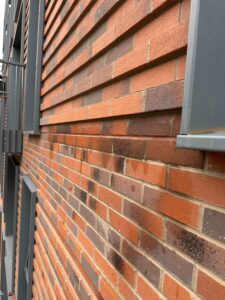 c & Silicone Replacement London
Ropeguys provides mastic and silicone replacement in London for commercial properties, apartment blocks and managed buildings with failed high-level perimeter seals, glazing edges and smaller external finishing joints. Using planned rope access, our technicians can reach window surrounds, façade trims, balcony interfaces and difficult-access details where a scaffold may be disproportionate to the work required.
This page focuses on smaller perimeter and finishing applications. Larger façade movement joints, construction joints and broad weather-seal programmes are covered separately on our sealant replacement London page. The distinction matters because a narrow silicone bead around a frame is not always the same technical problem as a designed movement joint between façade panels.
Ropeguys is supervised by experienced IRATA Level 3 personnel. Ionut Caimac has 18 years of published industry experience and Zoltan Abraham has 15 years. We combine difficult-access work with practical building maintenance and explain when a mastic or silicone replacement is likely to help, when a wider leak investigation is needed and when specialist façade input should be considered.
Ropeguys London
What Is Mastic and Silicone Replacement?
Mastic and silicone replacement is the controlled removal of failed flexible sealing material and installation of a suitable new bead to an agreed detail. In everyday building language, clients often use the words mastic, silicone, sealant and caulk interchangeably. On site, the correct product and preparation depend on the joint, substrate, exposure and purpose.
A direct answer for property managers
Rope access mastic and silicone replacement allows trained technicians to renew smaller high-level external seals around windows, glazing edges, trims and local interfaces without automatically scaffolding the full elevation. It is best suited to defined beads and perimeter joints where safe access, careful removal, clean preparation and controlled application are practical.
How this differs from sealant replacement
This page targets smaller finishing and perimeter seals: frame edges, glazing-adjacent beads, trims, local panel returns and selected balcony or roof-edge details. The external sealant replacement page targets larger façade movement joints, construction interfaces and weather-seal programmes where joint geometry, backing rod and movement capacity may dominate the specification.
The two services overlap, but they should not be merged blindly. A neat bead of silicone cannot compensate for a façade movement joint that has the wrong depth, missing backing material or an unresolved design issue. Equally, a small failed mastic bead around a window frame may be a focused maintenance issue rather than a full façade-joint programme.
Replacement versus topping up
Applying new silicone over old contaminated material is rarely the same as replacement. Old mastic can be dusty, oily, detached, brittle or poorly bonded. Covering it may improve appearance briefly while leaving the weak layer underneath.
Proper replacement normally means removing the failed bead, preparing the surfaces and applying the new material to clean, suitable faces. The level of removal and preparation should be agreed before work begins, especially where delicate coatings, painted frames or aged substrates are present.
Mastic cannot solve every leak
Failed mastic can admit water, but water may also enter through flashings, gutters, roof membranes, cracked masonry, failed mortar, cladding details or concealed construction. If the source of water ingress is unclear, a roof leak investigation or wider inspection may be the correct first step.
Product selection matters
Different products suit different surfaces and movements. Glass, powder-coated aluminium, uPVC, painted timber, concrete, masonry, stone and coated metal may require different preparation or primers. Some products are better suited to bathrooms and interiors than exposed external joints; others may stain natural stone or fail on contaminated surfaces.
Ropeguys does not treat “silicone” as one universal product. The proposed material must be compatible with the purpose of the joint and the condition found during access.
Ropeguys London
When Is Mastic or Silicone Replacement Needed?
Small seals often fail gradually. A bead can look acceptable from ground level while being detached at the edge, cracked along its centre or split at a corner. Close access is useful because many defects are only obvious from beside the joint.
Typical signs include:
- cracking or splitting through the silicone bead;
- gaps between the bead and frame;
- shrinkage at corners and ends;
- brittle, hardened or powdery old mastic;
- loose sections that lift away when touched;
- black staining, dirt traps or biological growth;
- repeated patching around the same detail;
- water marks below a window or trim;
- draughts around suitable external perimeters;
- failed beads discovered during window cleaning;
- paint or coating failure next to a sealed edge;
- old silicone smeared over the surrounding surface;
- missing local beads after other repair work.
Failed window perimeter beads
Window perimeters are common locations for smaller mastic and silicone replacement. The external bead may crack, detach from the frame, separate from masonry or pull away from a painted reveal. Before replacement, the team considers whether the bead is the likely weather seal or only a cosmetic finish.
Glazing and frame-edge details
Some glazing details are system-specific and must not be altered casually. Where the silicone is part of a glazing system, manufacturer guidance or specialist glazing input may be needed. Ropeguys can access and visually review the condition, but the correct responsibility must be clear before work proceeds.
Balcony and terrace interfaces
Small beads around balcony thresholds, trims and local interfaces can deteriorate through movement and weather exposure. These details can be associated with water ingress, but they may also interact with drainage, membranes and threshold design.
Finishing joints after repairs
Mastic may need renewal after brick repair, redecoration, cladding work, window maintenance or local roof-edge repairs. The replacement should usually follow substrate preparation and precede final cleaning or decoration where that sequence is specified.
Cosmetic failure versus weather failure
Not every poor-looking bead is the source of a leak. Some joints are primarily cosmetic, while others are part of weather resistance. Ropeguys separates appearance, access and function so the quotation is not based on guesswork.
Ropeguys London
Mastic and Silicone Replacement Services
External window perimeter mastic
We can replace suitable failed external beads around accessible window frames, including high-level elevations, courtyards and difficult corners. The scope identifies which sides of the frame are included and whether surrounding substrate defects are excluded or priced separately.
Glazing-edge silicone
Where the detail is suitable and responsibilities are clear, glazing-adjacent silicone can be renewed to improve local finish or address visible deterioration. Specialist glazing systems may require manufacturer or glazing-contractor guidance.
Small façade trim joints
Trims, cover strips, panel returns and façade edge details can contain narrow beads that split or detach over time. These are assessed separately from larger movement joints.
Balcony, sill and threshold details
Small perimeter beads around sills, thresholds, balcony interfaces and drip details can be replaced where access and substrate condition allow. Water tracking must be considered before assuming the bead is the only defect.
Local silicone repairs
Isolated failures can be addressed locally when the remaining material is sound and the stop points are sensible. Joining new silicone into old material may create a weaker interface, so the limitation is explained before approval.

Removal of poor previous patching
Previous repairs may include smeared silicone, unsuitable products or beads applied over dirt and loose material. Removal can be time-consuming, but it is often the difference between a tidy temporary patch and a proper replacement.
Colour and finish selection
Common colours may be available, but exact matching to aged frames, stained stone or weathered mastic cannot be guaranteed. Where appearance is critical, sample approval may be sensible before a wider programme.
Photographic records
Before-and-after photographs can be included where practical and agreed. They help building managers review inaccessible work and identify which elevations or details were treated.
Ropeguys London
Advantages of Rope Access for Smaller Sealing Work
Rope access can be efficient for high-level mastic and silicone replacement, especially when the work is localised. It is one access method among several and must be selected around the building, joint locations and practical working conditions.
Direct access to small details
Technicians can position close to a window perimeter, trim edge or glazing detail. This helps with careful cutting, cleaning and tooling, which can be difficult to assess from the ground.
Focused mobilisation
For a small group of high-level beads, scaffold may be disproportionate. Rope access can concentrate the visit on the defined locations and reduce the amount of temporary structure required.
Reduced ground footprint
London sites often have narrow pavements, entrances, courtyards, landscaping and basement structures. Rope access still requires exclusion zones and site control, but it may reduce the occupation of ground space.
Practical for occupied buildings
Small-joint replacement can often be coordinated around offices, residents, hotels and managed premises. Odour, noise, working hours, access to windows and public protection still need to be planned.
Inspection and replacement can be separated
Where the condition is uncertain, a close visual inspection can be completed before the replacement scope is confirmed. This avoids quoting a large programme from distant photographs alone.
When another access method is better
Scaffold or powered access may be better for extensive full-elevation sealing, heavy material handling, long-duration work or locations where rope systems cannot be established safely. Ropeguys will identify this during the access review.
Ropeguys London
Our Mastic and Silicone Replacement Process
1. Initial information
Send the postcode, building photographs, close-up images of the affected beads and any known water-ingress history. If the issue is around windows, identify whether the affected area is internal staining, external cracking, draughts or visible detachment.
2. Access and condition review
We review potential rope access arrangements, drop zones, public areas, roof or anchor access, window locations and practical working positions. The review also considers whether another access method may be more appropriate.
3. Scope definition
The quotation defines the locations, approximate linear metres, removal requirements, preparation assumptions, product type and any exclusions. It should also identify whether the work is appearance-led, maintenance-led or linked to an investigated water-ingress issue.
4. Planning and site coordination
Working hours, resident or tenant communication, keys, permits, exclusion zones, material handling and rescue arrangements are agreed before mobilisation.
5. Removal of failed mastic
Old material is cut out carefully. The method must balance thorough removal with protection of frames, coatings, glass edges and surrounding finishes.
6. Surface preparation
Joint faces are cleaned and allowed to reach a suitable condition. Moisture, dust, old residue, loose paint, damaged mortar or contaminated surfaces can prevent good adhesion.
7. Primer or preparation system
Some products and substrates require primer or specific preparation. Where this is necessary, it should follow the selected system and the agreed scope.
8. New bead application
The replacement material is applied and tooled to provide consistent contact and finish. The goal is not only a neat visible line, but a bead that is appropriate for the joint and substrate.
9. Weather and curing control
Rain, surface moisture, low temperature, strong sunlight and contamination can affect adhesion and curing. Work may be delayed or sequenced around suitable conditions.
10. Completion evidence
Photographs can record failed details, preparation and completed beads. Any hidden damage or wider defects discovered during access are reported separately.
Ropeguys London
Why Choose Ropeguys for Mastic and Silicone Work?
Experienced IRATA Level 3 supervision
Ropeguys publicly identifies Ionut Caimac and Zoltan Abraham as IRATA Level 3 Supervisors with 18 and 15 years of stated experience.
Small-joint focus
This service is written around perimeter beads, glazing edges and finishing joints rather than presenting every external joint as the same problem.
Preparation-led approach
We do not describe a quick bead over dirty, detached or brittle material as the same thing as replacement.
Related building-maintenance experience
Ropeguys also provides rope access maintenance, external redecoration, brick repair and roof inspection. This helps separate mastic failure from surrounding substrate problems.
Clear leak guidance
If the visible mastic is unlikely to be the whole cause of a leak, we say so. Some issues need staged investigation before replacement is the sensible next step.
Genuine project imagery
The website uses genuine Ropeguys high-level access photographs without inventing client names, insurance claims or unsupported project outcomes.
Ropeguys London
Industries and Buildings We Serve
Apartment blocks
Managed residential buildings often have high-level window perimeters, balcony details and courtyard elevations that are difficult to reach from the ground.
Commercial offices
Office buildings may require mastic renewal around window frames, trims and façade details while remaining occupied.
Hotels and hospitality premises
Appearance and timing matter on hospitality sites. Work can be planned around guest areas, entrances and operational requirements.
Retail and mixed-use buildings
Busy frontages need careful control of public routes, deliveries and access below the work.
Schools and public premises
Site procedures, working periods and safeguarding requirements should be provided before quotation so the method can be assessed.
Healthcare and sensitive occupied buildings
Odour, curing products, access restrictions and working hours may be more sensitive on healthcare or clinical sites.
Modern glazed and cladded buildings
Some details may form part of a proprietary system. Where that is the case, replacement should follow the correct product guidance or specialist specification.
Traditional masonry buildings
Window perimeters set into brick, stone or render can need careful preparation. Crumbling mortar, cracked masonry or loose paint must be addressed separately from the mastic bead.
Ropeguys London
Genuine Ropeguys Small-Joint Access Examples
These examples use genuine Ropeguys project imagery. Exact addresses and client identities are not published.
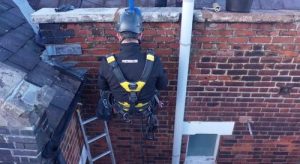
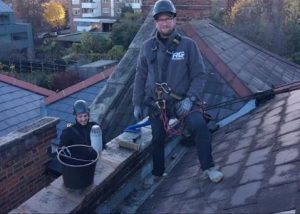
High-level window perimeter access
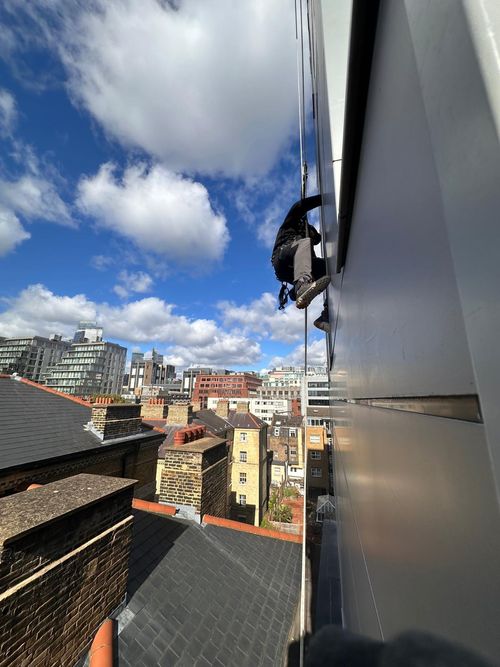
Ropeguys imagery shows technicians positioned beside high-level window and façade details, which is the type of access needed for close removal and re-application of small perimeter beads.
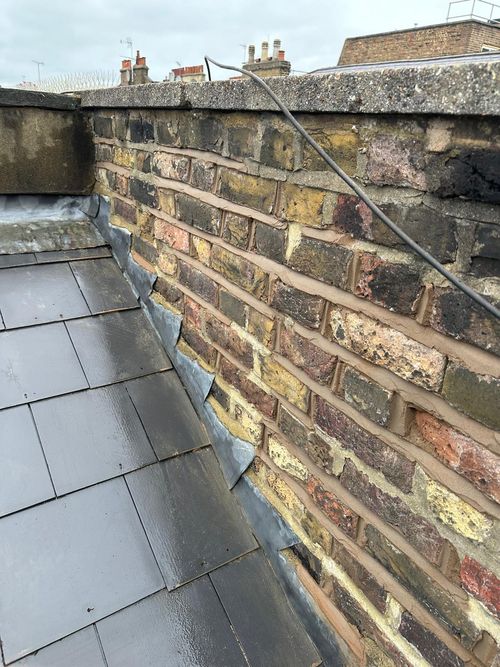
Close inspection of glazing and frame interfaces
Project photographs demonstrate why small failures can be difficult to judge from ground level. Close access helps distinguish cracked silicone, detached edges, substrate failure and staining from other causes.
Related façade and roof-edge details
High-level images also show how mastic, coatings, masonry, roof edges and panel joints can sit close together. The correct repair depends on identifying which component has failed.
What photographs can and cannot prove
Photographs can show visible condition, completed appearance and the area accessed. They cannot prove concealed façade design, product compatibility or a guaranteed leak cure without the right investigation and specification.
Ropeguys London
Mastic and Silicone Replacement Areas Covered in London
Ropeguys is based at 10 Florence Road, Kingston upon Thames, KT2 6JW, and works throughout Greater London.
Areas include Kingston, Richmond, Twickenham, Wimbledon, Putney, Wandsworth, Chelsea, Kensington, Hammersmith, Fulham, Westminster, Lambeth, Southwark, Croydon, Ealing, Brent, Camden, Islington, Hackney, Tower Hamlets and Greenwich.
Learn more about Ropeguys, visit Rope Access London or review the wider services hub.
Clear answers
Mastic and Silicone Replacement Frequently Asked Questions
What is mastic and silicone replacement?
It is the removal of failed flexible sealing material and installation of a suitable new bead after appropriate preparation.
Can you replace mastic using rope access?
Yes, where safe rope-access arrangements can be established and the joint locations are suitable.
Is mastic the same as silicone?
The words are often used loosely. The correct product depends on the substrate, exposure, movement and purpose of the joint.
Can you apply new silicone over old silicone?
Proper replacement normally requires failed material to be removed. Applying new silicone over old contaminated material may not restore adhesion.
Do you replace external window mastic?
Yes, suitable external window perimeter beads can be replaced within an agreed scope.
Can mastic replacement stop a leak?
It can help where a failed bead is the confirmed water path. If the source is uncertain, investigation may be needed first.
Do you work on glazing seals?
Suitable glazing-adjacent silicone can be considered, but proprietary glazing systems may require specialist guidance.
Can you colour-match mastic?
Available colours can be selected, but exact matching to aged frames, stained substrates or weathered material may not be possible.
How long does new silicone take to cure?
Curing depends on the selected product, bead size, humidity and temperature. The project plan should allow for the product requirements.
Does weather affect the work?
Yes. Rain, moisture, unsuitable temperature and contamination can affect adhesion and curing.
Can you work on occupied buildings?
Yes, subject to access, exclusion zones, communication and site controls.
Do you provide photographs?
Photographic records can be included where practical and agreed.
Is this suitable for internal bathrooms or kitchens?
Ropeguys mainly focuses on external and difficult-access building work. Internal domestic mastic may be better suited to an internal maintenance contractor unless it forms part of a wider managed-building project.
Are projects supervised by IRATA Level 3 personnel?
Ropeguys publicly identifies Ionut Caimac and Zoltan Abraham as experienced IRATA Level 3 Supervisors.
How do I request a quotation?
Call 07909 983036, email info@ropeguys.co.uk, send a WhatsApp message or complete the form below.
Free initial quotation
Request a Mastic and Silicone Replacement Quote
Send the property postcode, photographs of the affected details, approximate height, number of windows or joints and any known water-ingress history.
We will assess whether rope access is suitable and provide a written scope covering removal, preparation and replacement.
Tell us about the building
Include the postcode, approximate height and photographs where possible.